Commercial roofs are not one-size-fits-all assemblies. Our guide to commercial roofing systems looks at how common low-slope and metal options differ so property owners can compare performance, maintenance, installation, and building needs before selecting a system.
For owners evaluating commercial roofing in Atlanta, the starting point should be the building rather than a favorite material. Absolute Roofing Services outlines several commercial roofing options on its current service pages, including TPO, EPDM, built-up roofing, metal, modified bitumen, PVC, and coatings.
What are the main commercial roofing systems property owners should know about?
The main choices for low-slope commercial buildings include TPO, EPDM, PVC, built-up roofing, modified bitumen, metal, and selected roof coating or recover systems. Each uses a different material and installation method, so owners should compare roof design, exposure, traffic, reflectivity, repairability, drainage, and maintenance before deciding.
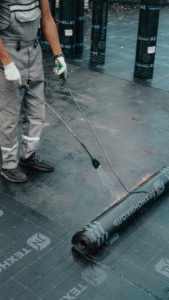
TPO, EPDM, and PVC are single-ply membranes. TPO and PVC typically use heat-welded seams, while EPDM uses compatible seam tapes, adhesives, and other system-specific details. Built-up roofing relies on multiple asphaltic plies, and modified bitumen uses reinforced asphalt-based sheets installed with approved methods for the selected product.
Reflectivity can also influence system selection. The US Environmental Protection Agency explains in its cool roof guidance that high solar reflectance reduces the amount of solar heat absorbed by a roof. Light-colored single-ply membranes, reflective coatings, and coated metal products can be part of a cool-roof approach, although building insulation, climate, and system design still affect the overall result.
How long does TPO roofing last in Atlanta weather?
TPO is often planned as a multi-decade commercial roof, but no single lifespan applies to every Atlanta building. Current industry guidance commonly places service in a broad range around two to three decades, while real results depend on membrane specification, installation, heat exposure, drainage, rooftop traffic, repairs, and ongoing maintenance.
GAF reports in an aged TPO field study that samples taken from roofs installed 8 to 16 years earlier were still performing above ASTM requirements for newly manufactured TPO in the study. That does not guarantee a particular Atlanta roof will achieve the same result, but it supports treating TPO life as a function of system design and actual field conditions rather than a fixed expiration date.
Heat can matter, especially around reflective walls, equipment discharge, dark rooftop components, or other local conditions that raise membrane temperature. Drainage also matters because recurring ponding can expose seams, penetrations, and membrane surfaces to longer moisture contact. Regular inspections help identify punctures, open details, blocked drains, or wear before these issues spread.
For owners considering TPO roofing in Atlanta, membrane thickness, attachment method, insulation package, perimeter design, flashing details, walkway protection, and the installer requirements of the selected manufacturer should all be part of the project discussion.
How do you decide between TPO and EPDM roofing for a commercial building?
TPO and EPDM can both work well on low-slope commercial roofs, but they address different priorities. TPO commonly offers a light reflective surface and heat-welded seams, while EPDM is a flexible rubber membrane with a long field history. The better choice depends on roof geometry, climate exposure, traffic, energy goals, detailing, and maintenance.
EPDM has a particularly long service record. The EPDM Roofing Association currently states in its service-life research summary that properly designed, installed, and maintained EPDM membranes have an expected service life of 38 years based on field evidence, laboratory work, and industry survey data. That figure is an association estimate, not a warranty for every EPDM installation.
TPO is thermoplastic, so seams are typically heat welded. EPDM is thermoset rubber and uses system-specific seam materials. TPO is commonly white or light colored, while EPDM is widely associated with black membrane but is also available in white. Roof traffic, grease or chemical exposure, equipment, drainage, existing substrate, and the required attachment method can shift the decision.
| Factor | TPO | EPDM |
| Material | Thermoplastic single-ply membrane | Synthetic rubber single-ply membrane |
| Seams | Commonly heat welded | Commonly joined with compatible seam materials |
| Surface choice | Often white or light colored | Commonly black, with white options available |
| Decision focus | Reflectivity, welded seams, specification, traffic | Flexibility, field history, detailing, exposure |
How does built-up roofing compare with single-ply systems?
Built-up roofing differs from TPO and EPDM because it creates the roof membrane from multiple asphaltic layers rather than one primary sheet. That layered construction can provide redundancy and a durable wearing surface, while single-ply systems use fewer membrane layers and place more emphasis on sheet attachment, seams, flashings, and puncture protection.
A traditional BUR assembly uses reinforcing plies with bitumen and a protective surface such as aggregate or a cap sheet. The exact design varies. Because the system is built in layers, local damage does not always expose the full roof assembly in the same way a puncture might affect a single-ply membrane.
Single-ply systems can offer faster installation and lower roof weight in many situations, but the comparison depends on the existing structure, local codes, attachment method, insulation, roof traffic, and project logistics. BUR may also require different staging and installation practices because of the materials used to create the multiple plies.
What are the top factors for choosing a commercial roofing system?
The top decision factors are roof slope and deck, drainage, building use, rooftop traffic, local exposure, insulation goals, equipment and penetrations, compatibility with the existing assembly, installation logistics, maintenance capacity, expected ownership period, and total lifecycle cost. Material should be selected after these conditions are understood, not before.
Start with the roof geometry and the deck. Slope and drainage affect where water moves, while the deck and existing insulation influence attachment and preparation. Next, consider what happens on the roof after installation. HVAC service paths, kitchen exhaust, solar equipment, signage, and repeated foot traffic can change where extra protection is needed.
Then look at lifecycle requirements. A lower initial price can be less attractive if the system demands maintenance the owner is unlikely to perform, creates disruption that the business cannot accept, or does not fit the expected ownership period. The same principle applies to energy goals: reflectivity is useful information, but insulation and the rest of the building envelope matter too.
How can property owners make a better long-term roofing decision?
A stronger roofing decision starts with verified roof conditions and a side-by-side comparison of systems that can actually work on the building. Owners should review preparation, attachment, seams, drainage, insulation, traffic, maintenance, repair options, warranty requirements, and expected service rather than choosing on material name or initial price alone.
At Absolute Roofing Services, we are a family owned and operated commercial roofing contractor serving Metro Atlanta. Our current service pages cover multiple low-slope and metal systems, and owners comparing options can review our TPO roofing service as one example of the systems we install and service.
A comparison should also account for alternatives such as built-up roofing in Atlanta when a layered asphaltic system fits the building better than a single-ply membrane. The aim is not to force one product across every roof, but to match the assembly to the property and its operating needs.
If you are evaluating metal roofing in Atlanta or another commercial system, we can help you discuss property-specific options. Contact Absolute Roofing Services to arrange a property-specific discussion of suitable roofing options.